
.jpg)
Radiant Health Medical Group
Project Type: UX/UI (Responsive Website)
client: Fictional (Online Course)
role: UX/UI Designer, Graphic Designer
tools used: Figma, Adobe Illustrator


Description
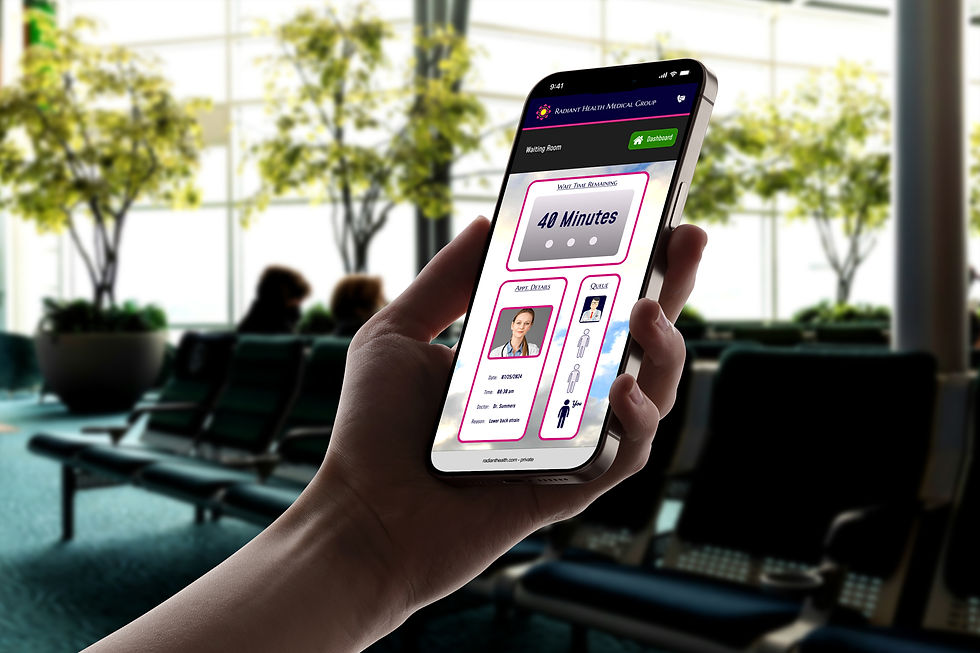
This project was part of the UX Design Google Certificate program on Coursera. The objective was to design a responsive website for Radiant Health Medical Group that enables patients to answer health screening questions and check in to their upcoming doctor appointments with ease. Acting as the UX/UI Designer, I managed all stages of the design process, including user research, wireframing, prototyping, testing, and mockups. The goal was to simplify the traditionally cumbersome check-in process by offering a streamlined, patient-friendly digital platform. My solution aimed to improve the patient experience by reducing repetitive form-filling, providing clear wait-time estimates, and offering a visually clean interface that minimizes cognitive load.
Process
The design process began with research to identify pain points associated with medical check-in and health screening procedures. I conducted a survey with 27 participants recruited through social media, using Survey Planet to collect responses and analyze pain points. My findings revealed common frustrations such as repetitive form-filling for returning patients, unclear wait times, and cluttered visual layouts. To address these, I outlined potential solutions, including a streamlined "new" vs. "returning" patient option, real-time wait-time updates, and a simplified, well-structured health screening questionnaire. Building upon these insights, I created a site map and information architecture to guide the design of the responsive website. Unlike previous projects, I skipped paper wireframes and moved directly to low-fidelity digital prototypes in Figma for efficiency. I self-tested the low-fidelity wireframes before progressing to high-fidelity designs, where I applied a clean, minimalist aesthetic aimed at enhancing readability and reducing patient frustration. For usability testing, I created a research plan and usability study script to measure KPIs and gather actionable insights. The high-fidelity prototype was tested with real users to identify pain points and validate design decisions. I compiled the findings into detailed documentation, pinpointing areas for improvement, and iterated on the design to address those issues. This process ensured the final design was user-friendly, intuitive, and visually clear.
Reflection
This project expanded my understanding of UX design in the healthcare sector, particularly how streamlined digital solutions can improve patient experiences. Designing for real-world applications like medical check-ins pushed me to think critically about user flow, accessibility, and the importance of clear information architecture. Exploring usability testing platforms also introduced me to new methods for gathering user insights efficiently. Overall, Radiant Health Medical Group was a rewarding challenge that demonstrated the impact of thoughtful design in simplifying complex, real-world tasks.
.jpg)
.jpg)
.jpg)
